How Sydney removalist pricing works
Understanding the real moving costs involved in a Sydney house move starts with one question: what counts as billable time, and how is it measured? Some operators start the clock when the truck leaves the depot; others from arrival at your front door. Some bill in 30-minute increments; others in 15-minute blocks. These distinctions can add hundreds of dollars to a final invoice without the customer understanding why.
The three things that actually determine value are: what the hourly rate includes, how time is measured and billed, and what happens if something goes wrong. Two quotes at the same hourly rate can represent entirely different products.
30-minute billing vs 15-minute billing
At $220/hr, a 30-minute billing block charges you $55 for any fraction — even 8 minutes. A 15-minute block charges $27.50 for the same overrun. Over a 4-hour move with a 22-minute overrun, that difference is $55. Always ask how time is billed before confirming any booking.
What Sydney removalists charge in 2026
Sydney removalists operate across four distinct pricing tiers. Rates have increased across all tiers over recent years, driven by fuel costs, wage growth, and higher insurance premiums. The rates below are for a 2-man crew and truck — the most common configuration.
| Tier | 2-man rate | What you’re getting | Risk |
|---|---|---|---|
| Budget / sole trader | $110–$145/hr | Basic equipment, limited or no goods insurance, variable crew quality | High |
| Mid-market | $145–$185/hr | Some systems, mixed crew training, partial insurance | Medium |
| Professional operator | $185–$245/hr | Trained crew, full insurance, proper equipment, transparent pricing | Low |
| Premium / specialist | $245–$320/hr | White-glove service, specialist item handling, full liability | Very low |
A 3-man crew adds approximately $55–$70/hr to any tier but typically completes jobs significantly faster. For larger moves, the extra hourly cost is very often recovered — and then some — in time saved. See Section 05 for the full explanation.
Sydney removalist cost estimates by home size
These removalist cost estimates assume a professional operator, straightforward access (ground floor or elevator with reasonable parking), and an average volume of belongings. Add 20–30% for walk-up stairs, long carries, inner-city parking difficulty, or above-average content volumes.
| Home type | Crew | Est. hours | Estimated total | Notes |
|---|---|---|---|---|
| Studio / 1-bed apt | 2 men | 2–3 hrs | $440–$660 | Minimum charge applies. Call-out included. |
| 2-bed apartment | 2 men | 3–5 hrs | $660–$1,100 | Upper end for walk-ups or inner-city access. |
| 2-bed house | 2–3 men | 4–6 hrs | $880–$1,680 | 3-man crew recommended for efficiency. |
| 3-bed apartment | 3 men | 4–6 hrs | $1,120–$1,680 | Elevator access reduces time significantly. |
| 3-bed house | 3 men | 5–8 hrs | $1,400–$2,240 | Sheds and garages add considerable time. |
| 4-bed house | 3 men | 7–10 hrs | $1,960–$2,800 | May require two trucks or a second day. |
These are planning estimates, not fixed quotes
Every move is different. Use these figures for budgeting. A written quote based on your specific home — whether you’re moving house in Sydney or relocating from an apartment — is the only number worth relying on. Moving house Sydney-wide — rates vary by suburb and access difficulty, so always get specifics.
What a Sydney removalist call-out fee actually covers
Almost every reputable Sydney removalist charges a call-out fee — and it is a completely legitimate charge that most customers don’t understand until they see it on the final invoice. This is one of the most preventable sources of surprise in the industry.
A call-out fee covers the real operational costs the removalist incurs before your move begins and after it ends. A crew of two travelling 30 minutes each way represents a full hour of wages plus round-trip fuel — costs incurred entirely on your behalf, before a single item is touched.
The call out fee itself isn’t the problem. The surprise is. Any operator worth booking will include it clearly on their written quote. If it’s absent, ask directly: “Is there a call-out fee, and exactly how is it calculated?” Vague or evasive answers to this question are a warning sign about the invoice you’ll receive at the end of the day.
2 men or 3 men? How crew size affects your Sydney moving cost
Most people default to the cheapest option — two men — without considering that a third person can make the move faster, safer, and in many cases significantly cheaper in total. The decision is more nuanced than the hourly rate difference suggests.
The truck-packing advantage of a 3-man crew
On a well-run 3-man job, one person stays in the truck while the other two carry. The person in the truck is responsible for packing everything correctly — heavy pieces against the cab wall, stable tiers built floor to ceiling, gaps filled with soft items, loads secured with straps after each section. This isn’t just about furniture safety. It means the carrying team never has to stop and wait for the truck to be reorganised between runs. They hand off each item and immediately return for the next. The rhythm is continuous.
On a 2-man job, both people carry and one of them has to climb into the truck and position each piece — breaking the carry flow at every single item. This adds time throughout the entire job, not just occasionally.
The maths often surprises people
Three men at $300/hr finishing in 5 hours costs $1,400. A 2-man crew at $220/hr taking 7.5 hours on the same job costs $1,650. The “more expensive” crew saved $250 and finished 2.5 hours earlier. For larger homes, difficult access, or above-average content volumes, ask specifically whether 3 men is the better option for your job.
The 3-man approach is especially valuable when access is poor — a long carry from the front door to the truck, multiple flights of stairs, or a tight inner-west terrace. If the carrying team has to work hard just to move items between the house and the truck, having a third person managing the truck means they never lose pace.
Ask the removalist what they recommend
A good operator will give you an honest recommendation based on your specific job. If they always default to 2 men regardless of job size or complexity, ask why. The answer will tell you whether they’re optimising for your outcome or for their hourly billing rate.
Sydney-specific challenges by region
Sydney’s geography — from Inner West terraces to Eastern Suburbs apartments, North Shore steep driveways to CBD loading zones — creates moving challenges that simply don’t exist in most other Australian cities. If your removalist hasn’t done dozens of jobs in your specific area, they may be encountering your suburb’s access problems for the first time — on your clock, at your cost.
CBD & Inner City
Loading zones limited to 30-minute maximum stays with $227 fines for violations. One-way streets and narrow laneways add significant time. Many CBD buildings ban moves outside strict time windows. Tradesperson parking permits require 5+ working days and cost around $56. Some buildings require lifts to be booked weeks in advance.
Inner West (Newtown, Glebe, Annandale, Surry Hills)
Victorian and Edwardian terrace houses as narrow as 3–5 metres wide with single-corridor layouts. Staircases too narrow for large furniture. Balcony hoists frequently needed — items lifted over railings. Large trucks often can’t navigate streets with parking on both sides. The most technically demanding suburb type in Sydney.
Eastern Suburbs (Bondi, Paddington, Vaucluse)
Scarce street parking across nearly every suburb. Heritage terraces in Paddington and Woollahra with tight doorways and no driveways. Bondi Beach and Kings Cross near-impassable at peak hours. High-density Bondi Junction buildings impose strict strata timeslots and lift bookings.
North Shore (Mosman, Neutral Bay, Pymble)
Steep driveways that can bottom out large trucks. Winding narrow streets in Killara, Wahroonga, and Pymble. Pacific Highway and Military Road are peak-hour bottlenecks. Some Milsons Point and Kirribilli buildings require damage deposits of $1,000+ before a move begins.
Apartment Move — all Sydney areas
For any apartment move, NSW Strata Law requires minimum 14 days’ notice in strata buildings. Lifts typically bookable Mon–Sat, 9am–4pm only — Sundays often prohibited. Damage bonds range from $50 to $2,000+. Removalists must provide proof of public liability insurance before being permitted access.
Toll Roads
Trucks pay approximately three times the car toll rate. A cross-city route using multiple toll roads (Harbour Bridge, Eastern Distributor, WestConnex, NorthConnex, Lane Cove Tunnel) can add $150+ to a move. Always confirm whether tolls are included in your quote or added separately.
Test your removalist’s local knowledge during the quote call
Ask whether they’ve done jobs in your specific suburb and what access considerations they’d flag. An experienced Sydney operator will immediately name your street’s challenges. A fresh operator will say “shouldn’t be a problem” — and then spend your time discovering it on move day.
Parking in Sydney — the moving cost nobody warns you about
Parking is one of the most overlooked cost factors in a Sydney move, and one of the most impactful. If the truck can’t park close to your front door, every single item has to travel further. On an hourly rate, this adds up quickly — and it compounds across every carry for the entire job.
Professional removalists plan parking before they arrive. They check both addresses in advance, identify loading zone access, and know from experience whether they need a smaller truck, a specific arrival time to beat council parking patrols, or pre-arranged reserved spaces. An inexperienced crew arrives, can’t park, circles the block for 20 minutes, parks 150 metres away, and then spends the next three hours carrying furniture twice as far as necessary. All on your time.
✓ Actions that protect your time and money
- Check parking signs at both addresses yourself — loading zone rules, time limits, no-standing zones
- Contact your council about tradesperson parking permits (allow 5+ business days)
- Book a strata lift slot minimum 2 weeks in advance for apartment buildings
- Discuss parking at both addresses explicitly during the quote call
- Consider asking neighbours to temporarily vacate their parking space on move day
- For inner-west terraces with no driveway, discuss smaller truck options in advance
✗ What causes expensive blowouts on move day
- Assuming parking “will be fine” in a dense inner-city suburb without checking
- Not notifying strata in advance — lifts unavailable, move blocked entirely
- CBD buildings with no approved loading zone nearby — truck parks 200+ metres away
- Arriving with a large truck on a narrow terrace street that can’t be navigated
- Parking inspector fines ($227) for exceeding loading zone time limits
- No one at the property to guide the truck to the best available spot
What should be included in every Sydney house move
Before comparing quotes for moving house in Sydney, understand what you’re actually comparing. A professional move and a budget move quoted at the same hourly rate are not the same product. The most significant differences are in what the budget quote has quietly removed.
✓ Should always be included
- Properly maintained truck of correct size for the job
- Heavy-duty quilted furniture blankets
- Shrink wrap for fabric items and upholstery
- Moving straps, trolleys, and load-bearing dollies
- Public liability insurance (minimum $5–10M)
- Goods-in-transit insurance
- Trained, experienced crew
- Fuel — both legs
- Floor and doorframe protection at both properties
✗ What budget operators often strip out
- Heavy-duty blankets replaced with thin alternatives or nothing
- Shrink wrap omitted — upholstery goes into truck unprotected
- Floor and doorframe protection — walls & floors at your risk
- Goods-in-transit insurance
- Fuel levy (appears separately on the invoice)
- Stair charges ($30–$60 per flight, added after the fact)
- Back-to-base/call-out charge (not disclosed at quoting)
- Credit card surcharge (1.5–3%, sometimes undisclosed)
The real cost of moving in Sydney: cheap vs professional
This is the calculation most people never do when working out the true cost of moving in Sydney. Scenario: a 2-bedroom Surry Hills apartment move — one flight of stairs, street parking 40 metres from the entrance, average furniture volume. Entirely typical for inner-Sydney.
Why cheap removalists cost more in the end
A very low hourly rate from any furniture removalist has to be subsidised somewhere. These are the consistent mechanisms by which it happens:
- 🐢 Slower crews
Less training means more time. On an hourly rate, slower = more expensive regardless of the rate.
- 💸 Hidden fees
Fuel, stairs, card surcharges, back-to-base fees — all absent from the quote, all on the invoice.
- 📦 Poor packing
Poorly loaded trucks mean extra trips, shifted furniture in transit, and items arriving damaged.
- 🪑 Damage risk
No goods insurance. No proper wrapping. When something breaks, there is no recourse.
- 📵 Day-of problems
Late arrivals and no-shows are far more common at the bottom of the market.
- 🤷 No accountability
Unreachable after move day. No complaints process. Your claim goes nowhere.
What Sydney movers actually complain about — and what great removalists do instead
The patterns in negative Sydney moving reviews are remarkably consistent. The same problems appear again and again. Understanding them is the most practical preparation you can do before booking — because every one of them is avoidable if you know what to look for.
Hidden furniture damage during a Sydney move
People imagine furniture removal damage as dramatic incidents — a wardrobe dropped down stairs, a screen cracked in the truck. These things do happen. But the far more common category of damage is cumulative surface wear: scuffing, grit transfer, and pressure marks from inadequate protective materials and poor truck loading.
A timber dining table moved without heavy-duty blankets will arrive with light scratches from contact with inadequately wrapped chairs. A leather sofa without shrink wrap attracts grit and surface scuffs in transit. These aren’t catastrophic — but you’ll notice them. And unlike clearly broken items, surface marks are difficult to claim. Without pre-move photographs and documented wrapping standards, the removalist can argue it’s normal wear and the claim goes nowhere.
How truck packing causes damage you won’t see until the truck stops
Safe truck loading is a genuine skill. Furniture needs to be positioned so weight is distributed correctly and nothing shifts when the truck brakes, corners, or hits a speed bump. An experienced crew packs to minimise movement and uses strapping to lock each section in place. An inexperienced crew packs fast — but furniture shifts in transit. Every Sydney roundabout, every hard stop, every lane change becomes a small collision between inadequately packed pieces. By the end of a 45-minute journey to the North Shore, the damage is done.
Moving antique furniture in Sydney — a completely different risk category
Antique furniture demands handling that most general removalists are not equipped for. The consequences of getting it wrong can be irreversible and extremely expensive. If you have pieces of genuine age or significant value, tell your operator specifically before booking — and if they can’t demonstrate knowledge of the risks, find someone who can.
Why antiques are different
French polish — the shellac-based finish common on Victorian-era and earlier furniture — is destroyed by moisture, alcohol, heat, and trapped humidity. Plastic wrap applied directly to a French-polished surface causes irreversible damage as moisture becomes trapped underneath. Repairing French polish involves rebuilding 100+ hand-applied layers of shellac: it’s costly, time-consuming, and never quite the same as the original. The correct protective layer is acid-free tissue paper as first contact, then moving blankets.
Veneer damage on antique pieces cannot be sanded back like solid wood — the surface layer is too thin. Any chip, lift, or gouge is effectively permanent without specialist restoration. Ratchet straps applied directly to veneered surfaces cause compression damage. Soft ties or blanket wrapping are the correct approach.
Aged joinery — dovetail joints, mortise-and-tenon construction, hand-cut dowels — loosens over time. What holds solid under normal use may not hold under the vibration and movement of road transport. Heavy items should be transported with their weight distributed properly, not just shoved in and left to rest on weakened joints.
High-risk items requiring specialist handling
| Item | The risk | Professional standard |
|---|---|---|
| Grandfather clocks | Internal damage to mechanism from vibration; pendulum, weights, and glass panels all separate risk points | Must travel upright. Pendulum, weights, and glass removed. Weights labelled Left/Centre/Right before disassembly — they are not interchangeable. |
| Marble-top tables | Marble cracks along natural vein lines under its own weight when transported flat | Marble tops always transported vertically — standing on edge — never laid flat. Separate from the base with padding between. |
| French-polished pieces | Plastic wrap traps moisture; scratches are permanent on shellac surfaces | Acid-free tissue as first contact layer. Blankets only — no plastic wrap directly on the wood surface. |
| Chandeliers | Crystal drops chip or shatter; brass arms bend under impact | Crystal drops individually wrapped in acid-free tissue. Never transported assembled. Arms padded separately. |
| Oil paintings | Canvas puncture, frame damage, surface cracking from temperature or pressure | Face-to-face packing with cardboard separation. Climate-sensitive pieces may need climate-controlled transport. |
Photograph and appraise before the move
Pre-move photographs of all antique and high-value items are essential. If you have pieces of significant value, a professional appraisal before the move means any damage claim is grounded in documented value rather than subjective estimation. Standard mover’s liability covers only a fraction of true antique value.
Moving TVs and electronics in Sydney — what a professional actually does
Televisions — especially modern OLED and large-format LED screens — are among the most commonly damaged items in moves, and among the hardest to claim on. The risk is significant and largely avoidable with the right handling standard.
Pre-move and post-move TV checks
A professional removalist checks the screen before the TV is moved and checks it again after it is placed at the destination. This is not optional — it is the standard that protects both the customer and the operator. A pre-move check documents the existing condition. A post-move check confirms no damage occurred in transit. The customer should be present for both checks and should agree the screen condition is unchanged before the crew leaves.
This sounds obvious. It is not standard practice across the industry. Customers regularly discover screen damage after the crew has gone, with no documentation and no recourse. If your removalist doesn’t mention this check, ask for it explicitly.
Why TVs are a high-risk item
Modern OLED screens have panels approximately 1mm thick with self-illuminating organic pixels and no backlight structure providing internal support. Even moderate, uneven pressure can fracture the organic layer without visible external impact — the damage may only become apparent when the TV is switched on. Damaged OLED panels cannot be repaired; the cost approaches or exceeds the price of a new television. TVs must always be transported upright: when laid flat, the screen glass presses directly on internal components, creating destructive pressure points.
✓ Professional TV handling standard
- Screen condition checked and confirmed with customer before disassembly
- All cables photographed before disconnecting — photograph the back of the TV
- Cables labelled individually and packed with their device
- Screen protected with microfibre cloth, then cardboard cut to size
- Bubble wrap over cardboard, secured without pressure on screen face
- TV transported upright — always — never laid flat
- Secured against truck wall; not free-standing in the truck
- Screen condition checked again with customer at destination
✗ What causes screen damage
- TV laid flat in the truck — even for “short” moves
- Screen rested against furniture without its own rigid support
- No protective padding on the screen face
- Cables tangled and pulled during disassembly from bracket
- TV bracket removed incorrectly — screen stress during bracket removal
- No pre or post-move condition check documented
- Packed in truck last minute with no securing
Entertainment systems and AV setups
Before any AV cables are touched, photograph the entire back of your TV and AV cabinet setup. This takes two minutes and saves hours of reconfiguration at the destination. Label each cable with masking tape — “TV HDMI 1”, “Soundbar”, “Console” — and pack them in labelled ziplock bags with their associated device. A good removalist will manage the physical packing; the cable documentation is something you should do yourself before move day.
Smart home devices — doorbells, hubs, smart globes — can be reconnected easily if you recreate the exact same Wi-Fi network name and password at your new home. Roughly 90% of devices will reconnect automatically without any re-pairing process.
Furniture disassembly and reassembly: what Sydney removalists handle
Professional removalists disassemble and reassemble furniture as part of the move — but the quality of this skill varies enormously, and the wrong decisions here can damage furniture that would otherwise have survived the move intact.
Flat-pack furniture presents a specific risk. Most flat-pack pieces are engineered to be assembled once: cam locks fatigue with repeated tightening, MDF screw holes enlarge after one or two disassembly cycles, and glued joints weaken. A skilled mover assesses each piece and makes a judgment call: move it whole, or disassemble it? Getting this wrong in either direction causes damage — a piece that was moved whole and couldn’t navigate a staircase, or a piece that was disassembled when it didn’t need to be and the MDF holes are now stripped.
✓ What skilled movers handle
- Bed frames — disassembly, hardware labelled in bags, reassembly at destination
- Flat-pack wardrobes and bookshelves where access requires it
- TV bracket removal from wall (screen removed first, then bracket)
- Picture rail and floating shelving removal
- Freestanding appliances — fridge, washing machine, dryer
- Dining table legs and extension sections
- Outdoor furniture requiring disassembly for access
✗ What requires a licensed tradesperson
- Hardwired electrical items (ovens, rangehoods, dishwashers)
- Gas appliances — disconnection and reconnection
- Air conditioning units (installation and removal)
- Plumbing connections (washing machine, dishwasher, ice-makers)
- Antenna or satellite dish removal from roof
- In-wall TV cabling or structured data cabling
- Structural wall fixings beyond standard hooks and brackets
Raise disassembly specifics during the quote call
If you have a large wardrobe that needs to come apart, a custom entertainment unit, or a bed with complex storage, mention it specifically. Experienced operators will ask about these items anyway — if they don’t, raise them. Vague or dismissive answers to specific disassembly questions are a signal about how carefully the crew plans before arriving.
These are the most common fees that appear on final invoices — whether it’s a unit move, apartment relocation, or full house move — without appearing in quotes. Some are legitimate charges that weren’t disclosed; others are invented on the day. Either way, your defence is the same: ask about every one of these explicitly before booking, and get the answer in writing.
| Fee | Typical range | Legitimate? | What to ask |
|---|---|---|---|
| Fuel levy | $40–$80 | Sometimes — depends on operator | “Is fuel included in the hourly rate or charged separately?” |
| Call-out / back-to-base | $60–$150 | Yes, if disclosed | “Is there a call-out fee and how is it calculated?” |
| Stair charge | $30–$60 per flight | Sometimes — depends on operator | “Are stairs at either property covered in the rate?” |
| Long carry charge | $30–$80 | Sometimes | “Is there any charge if the truck can’t park close to the door?” |
| Toll roads | $20–$150 | Yes, real costs exist | “Who pays tolls — are they included in your quote?” |
| Credit card surcharge | 1.5–3% | Yes, if disclosed | “Is there a surcharge for card payment?” |
| Heavy item charge | $80–$200 | Depends on item | “Are pianos, safes, or pool tables charged differently?” |
| Packing materials | Variable | Yes, if agreed | “Are shrink wrap and blankets included or charged separately?” |
Removalist insurance in NSW: what’s actually covered
This is the section most people skip — and the one they most wish they’d read. NSW law does not require removalists to carry insurance for your belongings. Most removalists carry public liability insurance, which protects your walls, floors, and property — not your furniture.
Goods-in-transit insurance is separate and covers your belongings during transport. Not all operators include it. Always ask specifically: “Do you carry goods-in-transit insurance, and can you provide a certificate of currency?” If the answer is evasive or they can’t produce the certificate, assume your belongings are uninsured.
Important limitations even when insurance exists: if you packed the boxes yourself, most policies don’t cover breakage inside those boxes. Insurance typically covers “all risks” during loading, transit, and unloading — but “all risks” has exclusions including inherent defects, gradual deterioration, and items of special value not declared before the move.
Declare high-value items before the move, not after
Antiques, artwork, jewellery, and electronics above a certain threshold need to be declared in advance. An undeclared $8,000 painting recovered at standard depreciated goods value might be compensated at a fraction of its worth. If an item matters to you financially, raise it before the move and get written confirmation of how it’s covered.
When something goes wrong during a Sydney move that wasn’t negligence
Not everything that goes wrong during a move involves negligence. A hidden fault in an old bed frame — a screw that had been working loose for years — can cause it to come apart during careful handling. A wardrobe panel that was already delaminating internally may split when lifted. An antique chair with a hairline crack in a joint that nobody knew about may not survive transport regardless of how carefully it was handled.
This is where the character of your removalist matters as much as their technical skill. In a dispute about negligence, you want people who are focused on reaching a fair outcome rather than avoiding blame. Budget operators with no systems and no accountability tend to disappear when things go wrong — or become aggressive about why it wasn’t their fault. Professional operators approach these situations differently.
The professional standard isn’t “we only take responsibility when we were clearly negligent.” It’s “something went wrong on your move day and we’re going to work with you to make it right.” That might mean helping you find a repair solution, contributing to the cost of restoration, or simply being honest and present throughout the process. Companies that behave this way post-move are easy to identify before the move — they’re the ones who respond to negative reviews publicly, engage with complaints directly, and have a documented process for resolution. Companies that go silent after payment behave the same way when something goes wrong.
How to identify outcome-focused operators before you book
Look at how they respond to negative reviews — not the perfect five-star ones. Do they engage, acknowledge, and offer resolution? Or do they respond defensively and blame the customer? This public behaviour is the clearest preview of how they’ll handle a difficult situation involving you. A company that ignores negative reviews will ignore your complaint too.
Best time to book a Sydney removalist in 2026
When you’re moving in Sydney, the timing affects both your cost and your options. Moving in Sydney — timing matters. Moving Sydney’s peak season can reduce your choice of reputable operators significantly. Demand peaks create higher rates at some operators and reduces the field of available, reputable companies significantly. Book early and book mid-week, mid-month wherever possible.
| Timing factor | Impact |
|---|---|
| Tuesday–Thursday, mid-month | Lowest demand. Best availability. Most negotiating power. |
| Weekends | Higher demand. Some operators apply weekend rates. Book early. |
| End of month (last 3 days) | Lease-driven peak. Hardest to find reputable operators. Higher rates. |
| December–February | Sydney’s peak moving season. Book 4–6 weeks in advance minimum. |
| 7–9am and 4–7pm, any day | Sydney traffic at worst. Add 30–60 minutes to any cross-city estimate. |
| School holiday periods | Moderate increase in demand from families with school-age children. |
Customer service: the best predictor of a good Sydney removalist
The quote call is a preview of your entire experience. How a company handles the five minutes of a quoting conversation tells you exactly how they’ll handle a problem on move day — because the same instincts drive both.
A good operator asks specific questions: How many bedrooms? Any large or heavy items — piano, safe, gym equipment? What floor are you on at both addresses? Is there lift access? What’s the parking situation? How much content are we talking — is it a light 2-bed or a fully furnished one? These questions aren’t bureaucratic — they’re how professionals build an accurate quote and plan a successful job.
✗ Warning signals on the quote call
- Quotes an hourly rate immediately, asks no questions about the job
- Vague or evasive when asked about specific fees (“depends on the day”)
- Can’t explain what their insurance covers
- Doesn’t ask about stairs, parking, or access at either property
- Pushy about locking in the booking before you’ve confirmed details
- Dismissive or rushed — clearly not interested in the specifics
✓ Positive signals on the quote call
- Asks specific questions about your home, contents, and access
- Explains all fees clearly and unprompted
- Gives a reasoned time estimate based on the specifics of your job
- Can explain their insurance coverage clearly and offers a certificate
- Mentions what they do to protect furniture and floors
- Doesn’t pressure you — gives you time to compare quotes
Call — don’t just email
A five-minute phone conversation reveals more than a week of email exchanges. Voice communication exposes the things a written quote can hide: whether the person knows what they’re talking about, whether they’re genuinely interested in your job, and whether you’d trust them with your home and your belongings for a full day.
How to read a removalist’s reviews
Review platforms are useful, but only if you know how to read them. The overall star rating is the least useful number on the page. What matters is the distribution, the pattern of complaints, and how the company responds to criticism.
What a healthy review profile looks like
A genuine review profile shows a natural distribution: a large cluster of 5-star reviews, meaningful numbers of 4-star reviews, some 3-star, and a small number of 1 and 2-star reviews. The lower reviews typically describe specific incidents — a late arrival, a minor damage claim, a billing dispute — and the company responds to each one, acknowledges the issue, and describes how it was resolved.
What a suspicious profile looks like
A Google reviews profile where 97–99% of ratings are 5-star with almost nothing in the 2–4 range warrants genuine scrutiny. No removalist company operating at scale over years produces only perfect experiences. Either reviews are being gated — only satisfied customers directed to leave reviews — or worse, the reviews are not organic. Look at whether the Google rating and the ProductReview rating match. Significant divergence between platforms is itself a signal.
Sort by lowest-rated first
The most useful reviews are the negative ones. Sort by lowest-rated and look for patterns: are complaints isolated incidents or does the same theme appear repeatedly? A company with 20 complaints all mentioning surprise fees on the invoice has a structural pricing problem, not bad luck. A company with 3 complaints in 500 reviews where two were clearly resolved is a normal, reliable operation.
Watch how they respond to negative reviews
Companies that engage publicly with negative feedback — acknowledge the issue, explain what happened, describe resolution — are demonstrating exactly how they’ll treat you if something goes wrong. Companies that respond defensively, blame the customer, or don’t respond at all are showing you something equally revealing. The response to the worst review on the page tells you more than the 200 five-star ones.
Red flags and green flags when comparing Sydney removalist quotes
Cash only, no card
Avoiding a paper trail is not a sign of a professional operation. It also leaves you with no recourse for payment disputes.
No ABN or physical address
An operator who can’t be found and has no registered business has no accountability. If something goes wrong, they’re gone.
Rate significantly below market
The Sydney market has real costs. A rate 30–40% below competitors means something has been stripped from the service.
No written quote provided
A verbal quote is not a quote. If they won’t put it in writing, the number means nothing.
Can’t explain their insurance
Professional operators know exactly what they carry and can produce a certificate immediately. Vague answers mean inadequate coverage.
Pushy booking tactics
“This price is only good for today” is a sales pressure tactic, not a legitimate logistics constraint. Walk away.
No questions asked about your job
A quote produced without knowing your floor, access, contents volume, or parking situation is not a real quote.
Review profile with no negatives
A 97%+ five-star profile from a company with hundreds of reviews warrants scrutiny. Perfect scores across thousands of moves don’t occur naturally.
Unknown subcontractors
If the people who arrive at your door aren’t the company’s own crew, ask who they are and whether they’re insured under the same policy.
Green flags worth noting
Detailed pre-move questions
They asked about access, parking, stairs, heavy items, and furniture specifics before quoting. This is professionalism, not bureaucracy.
Written itemised quote
Every component listed clearly. No ambiguous “additional charges may apply” language. What you see is what you pay.
Clear insurance explanation + certificate
They can tell you exactly what’s covered, what the limits are, and provide a certificate of currency on request.
Consistent review platforms
Rating on Google matches rating on ProductReview. Consistent scores across multiple independent platforms are hard to fake.
Responds to negative reviews properly
Acknowledgement, context, and resolution. Companies that handle criticism well handle problems well.
Doesn’t rush you to book
Confidence in their service means they don’t need to pressure you. They know the comparison will favour them.
Questions to ask your Sydney removalist before booking
Use these questions on the quote call. A professional operator will answer every one of them clearly and confidently. Evasion or vagueness on any of them is information worth acting on.
- 1What is the hourly rate, and what does it include? Are fuel, call-out fees, and GST included?
- 2How is time billed — in 15-minute or 30-minute increments?
- 3Is there a call-out or back-to-base fee, and how exactly is it calculated?
- 4Are stairs at either property charged separately?
- 5Do you carry goods-in-transit insurance? Can you provide a certificate of currency?
- 6What protective materials do you use — blankets, shrink wrap, floor runners?
- 7Who are the crew — are they your employees or contractors? Are they all covered under your insurance?
- 8Can you recommend 2 men or 3 men for my specific job, and why?
- 9Have you done many moves in my suburb? What access challenges should I know about?
- 10What is your process if something is damaged during the move?
- 11Are there any items — piano, marble, antiques, large artwork — that you charge differently for?
- 12Will you confirm the crew will call 30 minutes before arrival?
- 13Can I get all of this in a written, itemised quote?
Frequently asked questions about Sydney removalists
See what a professional Sydney quote actually looks like
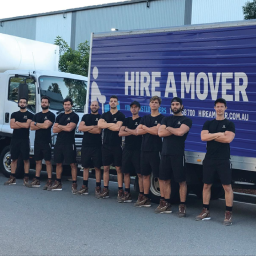
Hire A Mover has completed over 42,000 furniture removal jobs across Sydney and operates with transparent, all-inclusive pricing — no hidden fees, no surprises on the invoice. Our 700+ verified reviews from Sydney house moves and apartment relocations reflect what this guide describes: fast, careful crews who protect your belongings and your property.
- Written quote with every fee itemised before you confirm — furniture removal Sydney-wide
- Trained furniture removal crews with quilted blankets, shrink wrap, and floor protection as standard
- Goods-in-transit and public liability insurance included
- No fuel levy, no weekend surcharge, no credit card surcharge, no back-to-base fee
- Crew calls 30 minutes before arrival — every time
- 4.8 stars across 700+ verified customer reviews
Sources & further reading
- Australian Bureau of Statistics — household and migration data underlying Sydney moving demand
- Australian Furniture Removers Association (AFRA) — industry accreditation body for Australian removalists
- NSW Fair Trading — consumer protection and insurance requirements in NSW
- Transport for NSW — loading zone rules, council parking permits, and toll information